
Building an Orthopedic Supply Chain That Withstands Disruption

Key Takeaways:
- Resilience is more than a backup plan: The performance of the supply chain directly influences launch timelines, surgeon satisfaction, and patient outcomes.
- Redundancy and regionalization help mitigate risks: By diversifying suppliers, sterilization partners, and logistics hubs, you can create buffers against global and local disruptions.
- Digital visibility improves agility: Real-time inventory tracking and predictive analytics enable quicker responses to changes in demand and field conditions.
- Field inventory should be dynamic: Implementing reverse logistics and redeployment strategies maximizes asset utilization and minimizes waste.
- Integrated partnerships foster growth: Collaborating with a comprehensive logistics partner, like Millstone, ensures faster launches, improved compliance, and the capability to scale without compromising quality.
Built to Endure: Why the Orthopedic Supply Chain Must Be Resilient and Scalable by Design
Orthopedic manufacturers operate in one of the most demanding and critical sectors of medical device production. Every implant, every surgical set, and every logistics decision carries significant consequences—not just for business outcomes but for patient health. In this environment, reliability isn’t just a bonus; it’s an essential expectation.
Recent global disruptions, including pandemics, sterilization shortages, port backlogs, and delays in raw material deliveries, have revealed the weaknesses in many traditional supply chain models. These events did not create the vulnerabilities; they merely exposed them.
The stakes are exceptionally high for orthopedic original equipment manufacturers (OEMs). A delayed shipment is more than just a scheduling inconvenience; it can lead to a canceled procedure, a missed product launch, or a loss of a surgeon’s trust. Today’s market demands speed and a supply chain that is resilient under pressure and scalable in response to high demand.
By implementing the correct principles and proactive strategies, OEMs can establish a logistics foundation that is strong enough to withstand disruptions and agile enough to accelerate growth. Millstone’s integrated post-manufacturing capabilities provide a clear roadmap for achieving resilience and scalability.
Understanding Key Disruptions of an Orthopedic Supply Chain
Orthopedic supply chains are increasingly under pressure from various factors, including regulatory demands, logistical challenges, and operational issues. While innovation in implants and surgical systems is advancing, the infrastructure that supports these products often struggles to keep up. Identifying the most common and significant disruptions is crucial for building a resilient supply chain.
Several recurring issues continue to challenge traditional orthopedic supply chains:
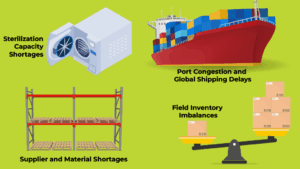
- Sterilization Capacity Shortages: Orthopedic devices depend heavily on validated sterilization methods, such as ethylene oxide (EtO). With limited sterilization facilities and rising demand, access bottlenecks are becoming more frequent, threatening time-to-market. The FDA has even identified sterilization capacity as a systemic vulnerability within the medical technology sector.
- Port Congestion and Global Shipping Delays: Components and finished devices are often sourced worldwide. Any interruption due to container shortages, geopolitical instability, or delayed customs processing can halt critical shipments and disrupt surgical schedules.
- Supplier and Material Shortages: Specialized materials, such as titanium and medical-grade polymers, are essential for orthopedic implants and instruments. A reliance on single-source suppliers or shortages of raw materials can lead to significant production delays and backlogs.
- Field Inventory Imbalances: Consignment models can lead to mismatched inventory levels across different regions, resulting in overstock in one area and shortages in another. Without real-time visibility and agile redistribution, companies may find capital tied up in idle inventory, leaving surgical cases in other locations unsupported.
Principles of a Resilient Orthopedic Supply Chain
To ensure continuity and efficient scaling, orthopedic original equipment manufacturers (OEMs) should design their supply chains around four essential principles:
Redundancy
Establish alternative pathways at every crucial point, including backup suppliers, additional sterilization partners, and diversified transportation networks. Redundancy is vital for maintaining operations when disruptions occur.
Regionalization
Regionalizing packaging, sterilization, and warehousing processes can decrease reliance on centralized networks. By situating operations closer to end markets, companies can reduce lead times and minimize the impact of localized disruptions, enabling quicker recovery and fulfillment.
Digital Visibility
Invest in integrated tracking systems providing real-time insights into component availability, inventory levels, and order status throughout the product lifecycle. This level of digital visibility empowers you to make proactive decisions and enables faster corrective actions when challenges arise, making your supply chain more efficient and agile.
Vendor Diversification
Source from various suppliers and logistics providers across different regions to avoid single points of failure. When evaluating vendors, consider quality and cost, transparency, reliability, and alignment with your operational objectives. This diversification strategy helps you mitigate risks and ensures a secure supply chain.
Proactive Strategies for OEMs Orthopedic Supply Chain
To build a supply chain that is resilient and capable of scaling, orthopedic original equipment manufacturers (OEMs) must implement proactive strategies that anticipate disruptions and enable flexibility from the ground up. These strategies are not just reactive measures but proactive steps that put you in control of your supply chain’s resilience and scalability.
Early Packaging and Sterilization Validation
Incorporate packaging and sterilization validation early in the development process. By using pre-validated packaging systems and scheduling sterilization slots in advance, you can eliminate last-minute bottlenecks and ensure readiness for product launches.
Inventory Pre-Positioning and Just-in-Time Fulfillment
Stage inventory in regional hubs near key surgical centers to reduce lead times and enable faster delivery. Combine this approach with Just-in-Time (JIT) fulfillment to build and ship surgical kits only when you schedule procedures. This strategy minimizes excess inventory while ensuring availability.
Demand-Driven Forecasting and Real-Time Analytics
Utilize predictive modeling and real-time usage data to allocate inventory dynamically based on actual procedure volumes. Integrated dashboards provide live visibility, enabling agile adjustments and precise lot-level tracking across warehouses and with field representatives.
Late-Night Fulfillment and Expedited Delivery
Support urgent surgical needs with extended order cut-offs and expedited shipping options. Overnight and white-glove logistics models ensure that implants, kits, and systems arrive precisely when and where needed, even for add-on procedures.
Reverse Logistics and Rapid Inventory Redeployment
Establish fast-turn reverse logistics for unused kits and field stock. This process retrieves, reprocesses, and redeploys inventory to areas where demand is increasing. This continuous circulation model optimizes asset utilization and reduces the burden of producing excess stock.
Scalable Infrastructure and Flexible Operations
Prepare for growth by partnering with logistics providers that offer modular cleanroom space, scalable distribution throughput, and trained personnel who can quickly ramp up during product launches or demand surges, without compromising quality or compliance.

Millstone Medical Outsourcing’s Integrated Approach for an Orthopedic Supply Chain
Millstone Medical takes a partner-first approach to orthopedic logistics. We design our integrated services to eliminate operational roadblocks, enhance responsiveness, and scale your business growth.
Packaging and Cleanroom Kitting
We operate ISO-certified cleanrooms for surgical kit assembly and final packaging. Our team handles complex configurations and packaging validations early, ensuring readiness and compliance well before launch deadlines.
Sterilization Coordination and In-House Testing
Millstone synchronizes packaging and sterilization workflows under one roof. With in-house testing labs for seal integrity, aging studies, and EO residuals, we streamline compliance and reduce cycle time, accelerating time-to-market.
Strategic Warehousing and Distribution
Our regional distribution centers situate products closer to demand. We support next-day delivery and late-night order fulfillment, backed by healthcare-compliant storage and real-time inventory tracking, so you always know what’s available and where.
Advanced Inventory Visibility
Millstone provides extensive UDI-level traceability through cloud-based dashboards and ERP-integrated systems. Our clients gain complete visibility from the warehouse to the point of care, enabling faster decisions and precise field support.
Efficient Reverse Logistics for your Orthopedic Supply Chain
Our closed-loop system for returns and redeployment transforms idle inventory into available assets. We inspect, reprocess, and redistribute returned products, minimizing waste and maximizing utilization.
Flexible and Scalable Operations for your Orthopedic Supply Chain
Our infrastructure is designed for flexibility, covering everything from packaging to distribution. Millstone can scale production, fulfillment, and inspection operations on demand to match your launch schedules and seasonal needs, ensuring uninterrupted delivery no matter how quickly you grow.
Future-Proofing Your Orthopedic Supply Chain
A resilient orthopedic supply chain must do more than react to disruption—it must enable long-term growth, competitive differentiation, and surgical reliability. OEMs that embrace strategic logistics are better equipped to adapt, scale, and thrive.
Millstone Medical Outsourcing delivers integrated capabilities and proven orthopedic expertise to help you future-proof your supply chain. From launch readiness to field deployment, we ensure your devices arrive on time, every time, with the compliance, speed, and reliability your customers expect.